Humpies / Pink Salmon
Fishing Charters
Seattle / Puget Sound Washington
How To Fish For Pink Salmon In Puget Sound
The Pink Parade: Fishing for Humpies on a Puget Sound Charter
When the odd-numbered years roll around, the Puget Sound transforms as millions of Pink Salmon (Humpies) return to their home rivers. For anyone looking for high-volume action, there is no more exciting way to experience these runs than from the deck of a professional charter boat. While King Salmon are the “Prized Trophies,” Pinks provide non-stop, rod-bending fun for everyone on board.
If you are stepping onto a charter to fish for these chrome-bright acrobats, here is how we use our boat, our gear, and our experience to find the schools.
The Fishing Strategy: Trolling the Top Floor
On a charter, our favorite way to fish for Pinks is Trolling. Unlike the big King Salmon who often stay in the deep, cold “basement” of the ocean, Pinks are social travelers. They stay in massive schools in the top 30 to 60 feet of the water column.
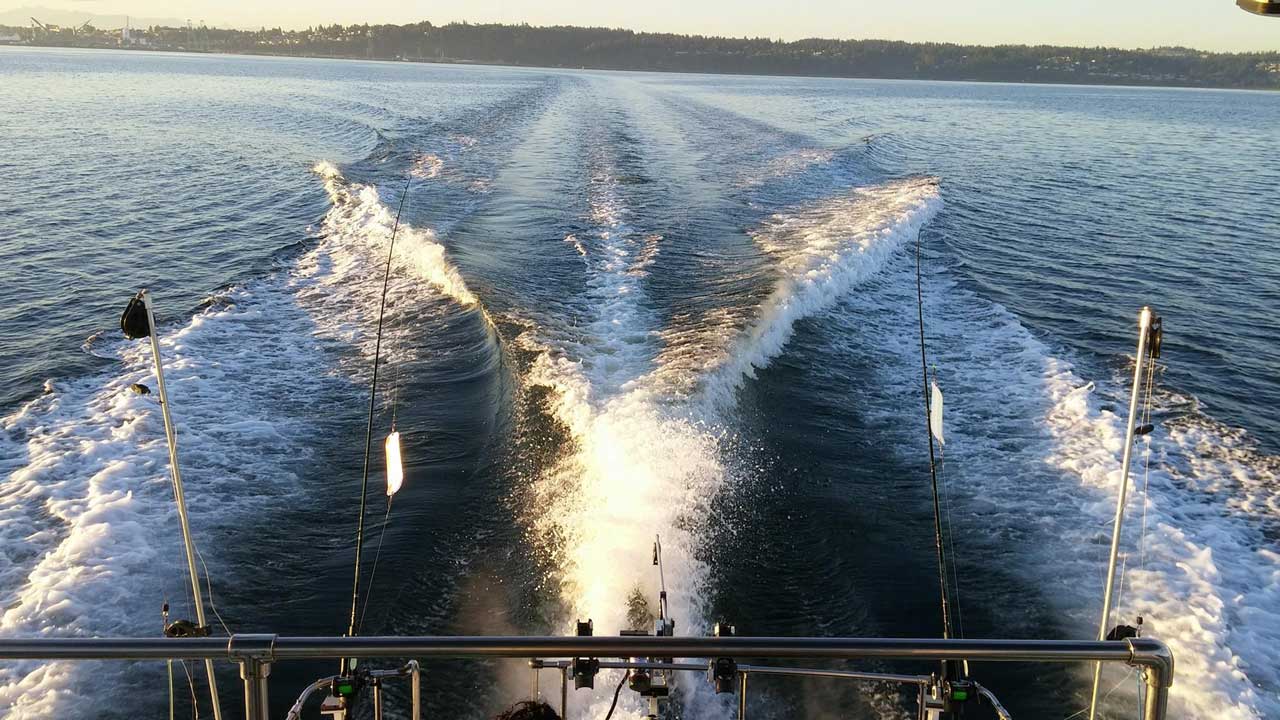
Think of the charter boat as a moving scout. We use the engine to pull our lures through the “travel lanes” where the schools are thickest. Because we are moving at a steady 1.5 to 2.0 knots, we can cover miles of the Sound in a single morning. If the fish aren’t in the “Shipwreck neighborhood,” we simply pull up the lines and drive to “Possession Point.” By staying mobile, we ensure you are always where the fish are.
The Secret Weapon: Seeing Pink
If you looked at a Pink Salmon’s favorite lures, you’d find one consistent theme: Pink. These fish are famous for their aggressive reaction to anything bright pink.
On the charter, we use specialized gear to trigger this strike:
-
The Flashers: We deploy 11-inch “High-Vis” pink or glow-in-the-dark flashers. As they spin, they look like a strobe light underwater, signaling to every Pink in the area that bait is nearby.
-
The Lures: Behind the flasher, we trail a small Pink Hoochie (a rubber squid) or a pink-and-white spoon. We use shorter “leaders” (the line between the flasher and the lure) for Pinks—usually about 22 to 26 inches—to give the lure a frantic, snapping action that Pinks find irresistible.
The Scouting Method: Finding the School
A great charter captain doesn’t just look at the sonar; they look at the horizon. In the Puget Sound, we look for surface signs to find the fish. If we see a “Bait Ball” on the electronics or a flock of gulls and terns diving and screaming, we know we’ve found the school. Those birds are hovering over Pinks that have pushed thousands of tiny herring to the surface. We troll the edges of these bird piles to intercept the hungry salmon underneath.
Light Gear, Heavy Action
One of the best parts of a Pink Salmon charter is the gear. Because Pinks usually weigh between 3 and 6 pounds, we don’t need the “heavy-duty” rods used for 30-pound Kings. We use medium-light action rods that let you feel every head-shake and acrobatic leap.
Pro Tip for the Fight: Pinks have notoriously soft mouths. When the rod buries into that classic U-shape, don’t jerk the rod to set the hook. On a charter, the boat’s forward motion does the work for you. Simply lift the rod, keep a steady bend, and let the reel’s drag do its job.
The Reward
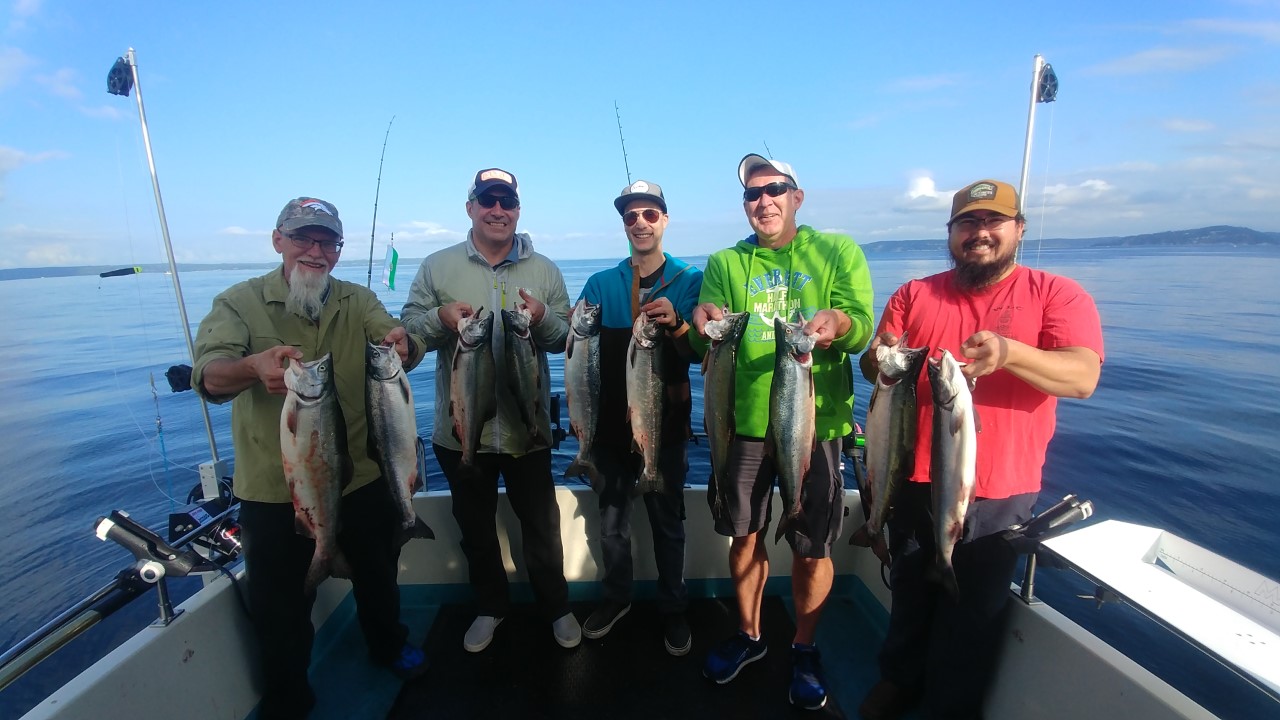
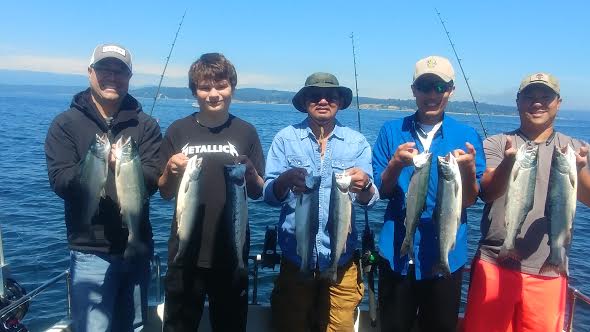
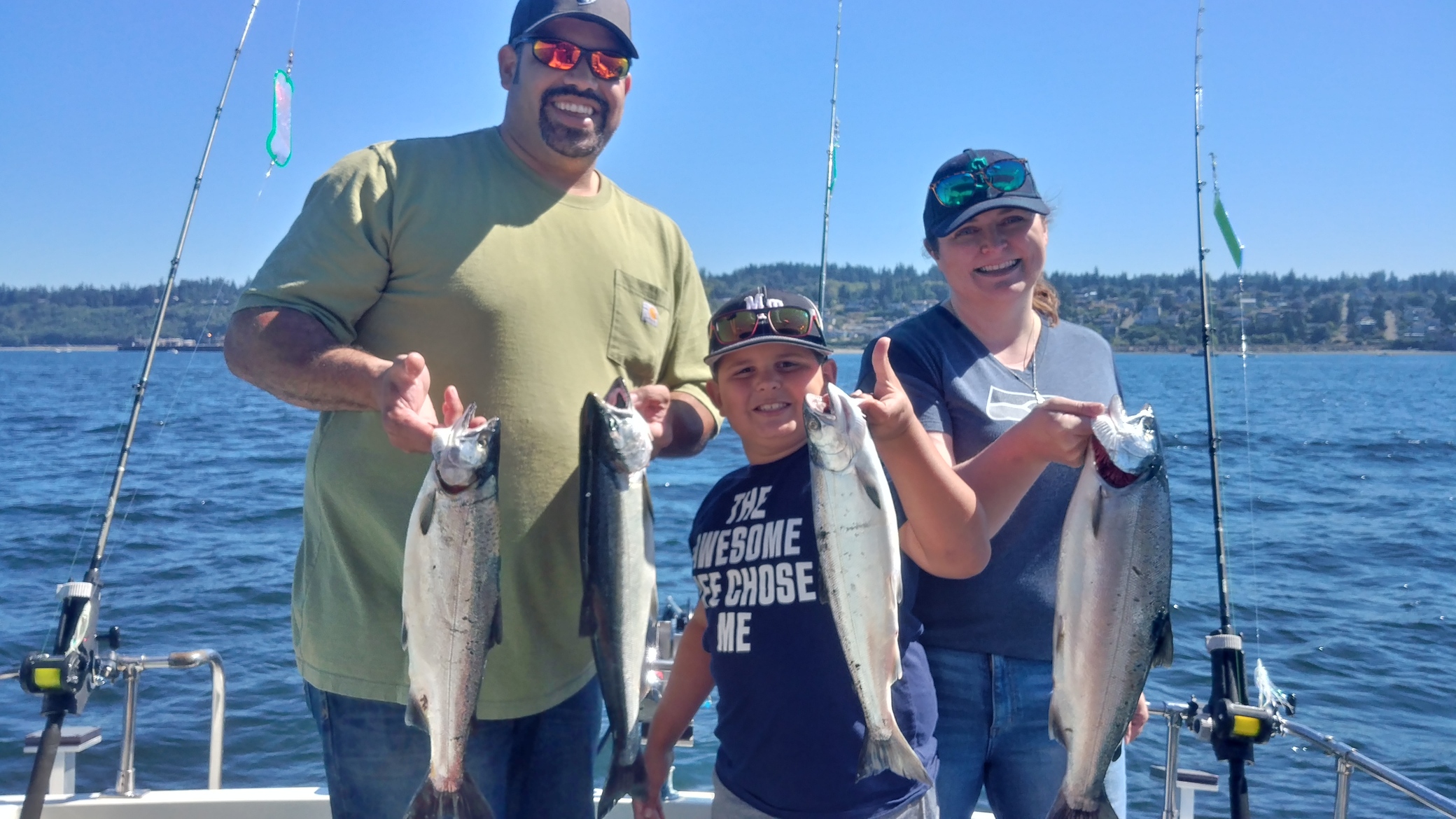
By the end of a successful trip, the fish box is usually full. These fish are fantastic table fare when caught in the saltwater of the Sound—their meat is lean, mild, and takes on a beautiful smoky flavor on the grill. On a charter, you aren’t just out for a boat ride; you are part of a coordinated effort, using professional electronics and local knowledge to bring home a limit of Puget Sound salmon.
FAQ’s
Do you run Pink salmon trips every year?
Pink salmon (affectionately known as “Humpies”) run almost exclusively on odd-numbered years (e.g., 2027, 2029). Millions of them flood into the Puget Sound all at once, making it the highest-action salmon fishery we offer. On even years, they are virtually absent.
Why are Pink salmon trips recommended for families and beginners?
Because they travel in massive, dense schools near the surface and bite readily on almost anything pink. The action is fast, steady, and light-tackle-friendly. There is very little waiting around, which keeps kids engaged the whole trip.
What is the daily limit for Pink salmon?
During a peak Pink run, WDFW usually rewards anglers with generous limits. The standard limit is typically 2 salmon per day, but the state frequently adds a “bonus limit” allowing an extra 2 Pinks per person, meaning you could go home with 4 fish each.
How do you target Pink salmon out of Edmonds?
We use light-tackle rods and troll or cast small, bright pink spoons, jigs, and pink squids. Because they swim in the top 30 feet of water, we don’t need heavy deep-water gear, making the fight highly interactive.
Are Pink salmon good to eat?
Yes, but they must be handled correctly. Pink salmon have softer flesh than Kings or Coho. To ensure great table fare, we bleed and ice them down immediately on the boat. They are excellent when eaten fresh that week or put in the smoker.
Why Pinks Only Show Up Every Other Year in Puget Sound.
The Two-Year Clock: Why Pink Salmon Are the “Oddballs” of the Sound
If you’ve spent any time fishing the Puget Sound, you’ve likely noticed a strange pattern: some years the water is practically boiling with silver-sided fish, and the next, it’s like they’ve vanished entirely. While King (Chinook) and Coho salmon return like clockwork every single year, the Pink Salmon (or “Humpies”) follow a strict, biennial schedule.
To understand why this happens, you have to look at the unique biological “clock” that governs the life of a Pink Salmon and how it differs from every other salmon in the forest of the sea.
The Strict Two-Year Life Cycle
Most salmon species are flexible. A King Salmon might spend three, four, or even five years in the ocean before deciding it’s time to head home.
Pink Salmon are different. They are the fastest-growing and shortest-lived of all Pacific salmon. Their life cycle is locked into a rigid two-year window:
-
Year 1: They hatch in freshwater and head immediately to the salt.
-
Year 2: They spend 18 months gorging on krill and small fish in the ocean.
-
End of Year 2: They return to their home river, spawn, and die.
Because they always return at age two, the populations are split into two completely separate groups: the “Odd-Year” fish and the “Even-Year” fish.
The “Empty” Even Years
This leads to the big question: If there are odd-year fish and even-year fish, why don’t we see them both in Seattle?
In many parts of Alaska, rivers have massive runs in both even and odd years.
Because Pinks are so strictly tied to that two-year clock, there were no “three-year-old” stragglers to restart the population the following year. Once that even-year line was gone, it stayed gone. The odd-year fish continued to thrive, returning every two years to rebuild their numbers, leaving the even years quiet.
The Ecological Wave
This biennial schedule creates a massive “pulse” in the ecosystem. In an odd year (like 2025 or 2027), millions of Pinks flood the Sound, providing a feast for whales, seals, and eagles. When they move into the rivers, they bring a massive “shipment” of nutrients from the ocean that feeds the entire forest.
In the even years (like 2026), the “forest” gets a break. While you might see a stray Pink here or there, there aren’t enough to form the massive schools we see in the “on” years.
What This Means for the Fisherman
For those of us fishing the Puget Sound, this means we have to adjust our “treasure map” depending on the year:
-
Odd Years: This is the time for high-volume action.
The “Pink Parade” is in town, and the fishing is fast, shallow, and fun. -
Even Years: We shift our focus entirely to the Resident Coho and the Big Kings. While we miss the sheer numbers of the Humpies, it allows us to focus on the “Acrobats” and “Kings” of the Sound.
Understanding the two-year clock of the Pink Salmon makes you a better student of the water. It’s a reminder that in the Pacific Northwest, nature doesn’t always follow a straight line—sometimes, it moves in a two-step dance.
Will I catch a Tyee King Salmon?
The answer is a definitive maybe. Many fishermen fish for decades and never bring a King Salmon into the boat over 30 pounds where at times a novice fisherman will sometimes catch a Tyee on their first outting.
All I can say is that you don’t hit the ball unless you swing at it.
Think of catching a Tyee as a gift from the Fishing Gods that will be burned into your memory for a lifetime.