Chum Salmon Fishing Charters
Seattle / Puget Sound Washington
How To Fish For Chum Salmon In Puget Sound
The Dogfight: Fishing for Chum Salmon on a Puget Sound Charter
As the summer crowds fade and the autumn rains begin to cool the emerald waters of the Puget Sound, a new kind of treasure arrives. Chum Salmon, often called “Dog Salmon” due to the impressive teeth the males develop, are the heavyweight champions of the late fall. While King Salmon are known for their prestige and Coho for their acrobatics, Chum are known for one thing: raw, stubborn power.
If you are joining a charter during the peak window of late October through mid-November, you are preparing for some of the most intense, high-volume fishing of the year. Here is how a professional charter boat targets these powerful fish in the “neighborhoods” of the Sound.
The Strategy: Intercepting the Migration
Chum Salmon don’t wander aimlessly; they are on a mission to reach their home rivers in the South Sound and Hood Canal. A charter captain’s primary goal is to find the “choke points”—underwater geography like Jefferson Head or the Point Defiance Narrows—where the current forces these massive schools to congregate.
Unlike King fishing, where we often hunt deep near the “basement,” Chum are notorious surface travelers. On a charter, we keep our gear in the top 20 to 60 feet of the water column. Even in hundreds of feet of water, these fish prefer to cruise the upper layers. We watch the surface constantly; a single “fin” breaking the water or a heavy splash is often all the evidence we need to steer the boat into a school of thousands.
The Secret Colors: Purple and Green
If you look at the gear we use for King or Coho, you’ll see a lot of silver, white, and glow. But for Chum, we change the palette entirely. For reasons only the fish know, Chum have a violent attraction to Chartreuse (neon green) and Purple (cerise).
-
The Trolling Setup: We deploy large, bright green or purple flashers that create a massive “thumping” vibration and light show. Behind these, we trail “Hoochies” (rubber squids) in the same electric colors.
-
The Scent Trail: Chum have an incredibly sensitive sense of smell. On a charter, we often tip our hooks with a small piece of “cured” herring or a bit of shrimp to create a scent trail that leads the school straight to our lures.
The “Mooching” Alternative
When the schools are particularly thick, a charter captain might switch from trolling to Mooching. This is the “Waiting Way,” but with a twist. We find a school on the electronics and have everyone on the boat drop their weighted bait straight down. We slowly reel up and down through the school. When a Chum hits a mooching rig, it isn’t a subtle tap—it’s a freight train. This method allows for multiple “double” and “triple” hookups, turning the deck into a scene of exciting, controlled chaos.
The Fight: Gear and Technique
Chum earn their “Dog” nickname by being incredibly stubborn. They don’t jump like Coho; they put their heads down and use their broad, powerful sides to pull against the boat.
On the charter, we use medium-heavy rods with high-quality “Level Wind” reels. The drag system is the most important tool here. A big Chum can weigh 10 to 20 pounds, and they will make long, powerful runs that can strip line in seconds.
-
Pro Tip: Keep the rod tip high and maintain constant pressure. If you give a Chum a single inch of slack, they will use their strength to shake the hook loose.
The Reward: The Grand Finale
By the time the sun begins to set on a November afternoon, the fish box is usually heavy. While some people overlook Chum, those who know the “forest” understand that saltwater-caught Chum are a fantastic prize. Their meat is lean and firm, making them the absolute best choice for smoking or for hearty fall grilling.
Fishing for Chum on a charter is the ultimate way to close out the salmon season. It is a game of strength, specific colors, and professional scouting that proves the “Dog Salmon” is a treasure well worth the hunt.
FAQ’s
When do the Chum salmon arrive, and what makes them special?
Chum are our late-season warriors, entering the Sound from mid-October through November. Anglers look forward to them because pound-for-pound, they are arguably the hardest-fighting salmon in the Pacific Northwest—often nicknamed “Dog Salmon” for their canine-like teeth and sheer bulldog attitude.
What kind of gear and techniques do we use for Chums?
Chum have unique feeding habits. We target them along deep current lines by slow-trolling or drifting with green, purple, or pink colored mini-hoochies tipped with a small piece of fresh shrimp.
Are the Chum salmon we catch bright or already in spawning colors?
Catching them out of Edmonds means we intercept them while they are still in the saltwater. They are still bright, hard, silver “ocean-bright” fish, which gives you the maximum fight and the best meat quality before they hit the rivers.
What is the average size of a Puget Sound Chum?
They are large salmon, second only to the King. The Chums we bring aboard typically range from 10 to 18 pounds, and their powerful, deep runs will test any angler’s forearms.
How is Chum salmon best prepared for cooking?
Chum is lower in fat content than Kings or Silvers, meaning it has a dryer texture. Because of this, it is the absolute premier choice for home smoking, kippering, or making high-quality salmon jerky.

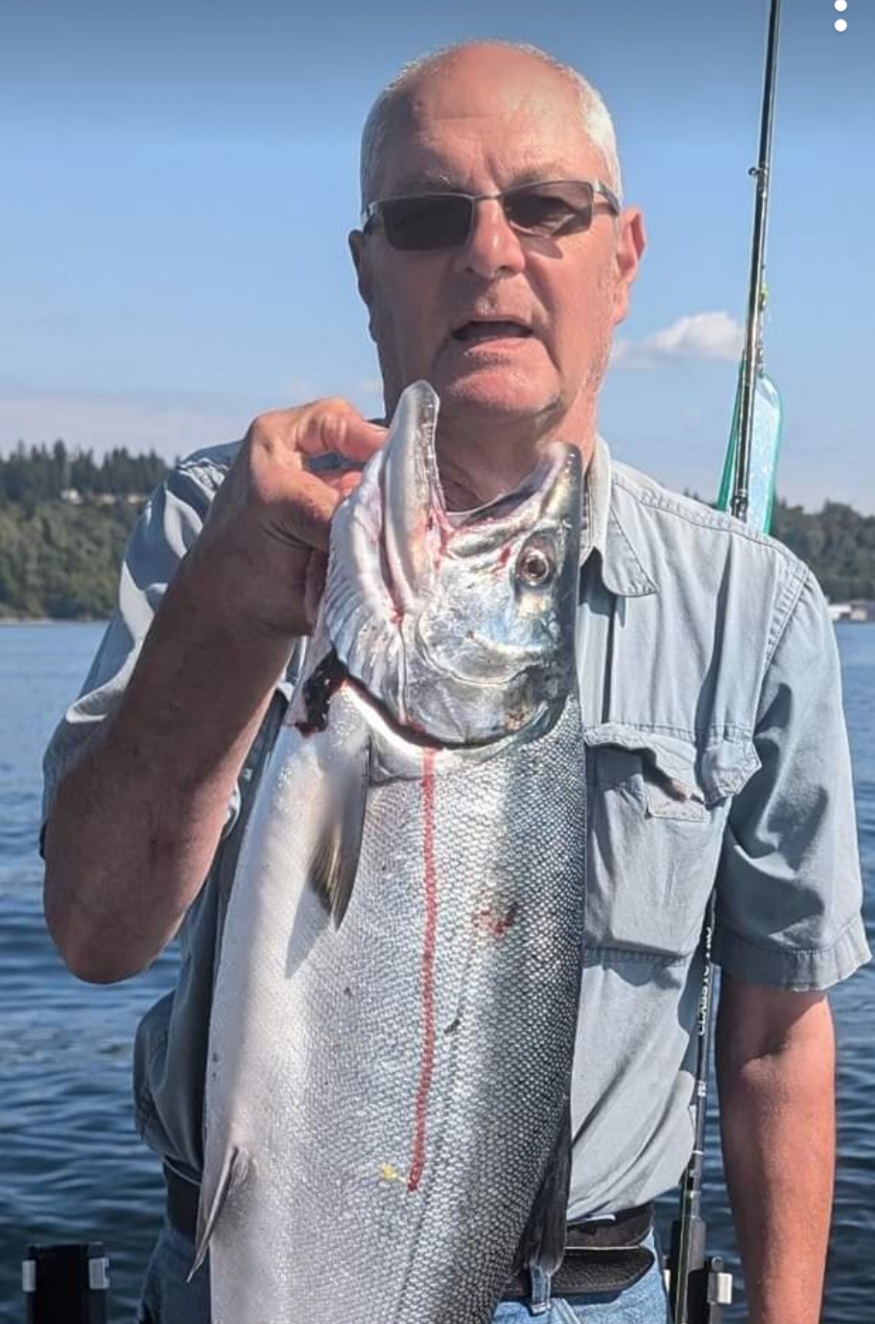

Why Are Chum Salmon Also Known As Dog Salmon?
The Dog of the Sound: Unmasking the Power and Legend of the Chum Salmon
In the saltwater “forests” of the Pacific Northwest, every salmon has a nickname. The Chinook is the “King,” the Coho is the “Silver,” and the Sockeye is the “Red.” But the Chum Salmon carries a title that sounds more like a warning than a label: the Dog Salmon. To the uninitiated, it might seem like an insult to such a massive fish, but to those who have felt the strain on a fishing line in November, the name is a badge of honor.
The “Dog” moniker and the legendary strength of the Chum are two sides of the same coin, rooted in both their ancient history and their unique biology.
The Legend of the “Dog”
There are two primary reasons why the Chum became known as the Dog Salmon, one based on what we see and the other on how the fish was historically used.
The Physical Transformation: When Chum Salmon are in the open ocean, they are “chrome bright” and look much like any other salmon. However, as they approach the freshwater “neighborhoods” where they were born, they undergo a terrifying transformation. The males develop a massive, hooked snout (kype) and grow large, protruding canine-like teeth. These teeth aren’t for eating—Chum actually stop feeding once they enter the Sound—they are for combat. They use these “dog teeth” to bite and ram other males while competing for the best spots to spawn.
The Working Man’s Fish: Historically, the name also stems from its importance to indigenous cultures and early settlers. Because Chum are lower in fat than Kings or Sockeye, their meat dries and smokes exceptionally well without going rancid. In the far north, dried Chum was the primary food source used to sustain sled dog teams through the long, frozen winters. It was quite literally the “dog’s salmon,” a high-protein fuel that powered the engines of the North.
Why They Fight So Hard
If you ask a fishing guide which salmon puts up the most stubborn fight, many will skip the King and go straight to the Chum. They don’t have the “flash” of a Coho or the high-speed runs of a Chinook; instead, they offer a “dogged” persistence that tests the limits of your gear.
1. The “Broadside” Advantage: Chum are built like tanks. They have deep, slab-sided bodies that are much wider than the sleek, torpedo-shaped Coho. When a Chum realizes it’s hooked, it doesn’t just run away—it turns its broad body sideways against the current. This creates a “parachute effect,” using the force of the moving water to pull against the fisherman. It is like trying to reel in a piece of plywood in a windstorm.
2. Pure Muscle Density: Because Chum spend their lives eating a diet rich in jellyfish and krill, they develop a dense, powerful muscle structure designed for endurance rather than short bursts of speed. A Chum won’t give up after the first two runs. They are “head-shakers,” using their powerful necks and those canine-studded jaws to thrash at the line, trying to use the weight of their own bodies to snap the leader.
3. The Late-Season Surge: By the time Chum arrive in the Puget Sound in late October, they are at the absolute peak of their physical strength. They are “swollen” with the energy needed to navigate the final miles of their journey. They aren’t looking for a snack; they are looking for a fight. When they see a bright green or purple lure in their “living room,” they attack it out of pure aggression.
The Final Round
Hooking a Dog Salmon is like getting into a heavyweight boxing match where the opponent refuse to go down. They will stay deep, circling under the boat for twenty minutes or more, making you earn every inch of line. It is this combination of prehistoric teeth, broad-shouldered strength, and a “never-say-die” attitude that makes the Chum Salmon the ultimate grand finale to the Pacific Northwest fishing season. When you finally bring a 15-pound “Dog” to the net, you’ll understand exactly why they earned their name.
Will I catch a Tyee King Salmon?
The answer is a definitive maybe. Many fishermen fish for decades and never bring a King Salmon into the boat over 30 pounds where at times a novice fisherman will sometimes catch a Tyee on their first outting.
All I can say is that you don’t hit the ball unless you swing at it.
Think of catching a Tyee as a gift from the Fishing Gods that will be burned into your memory for a lifetime.